May 14, 2026
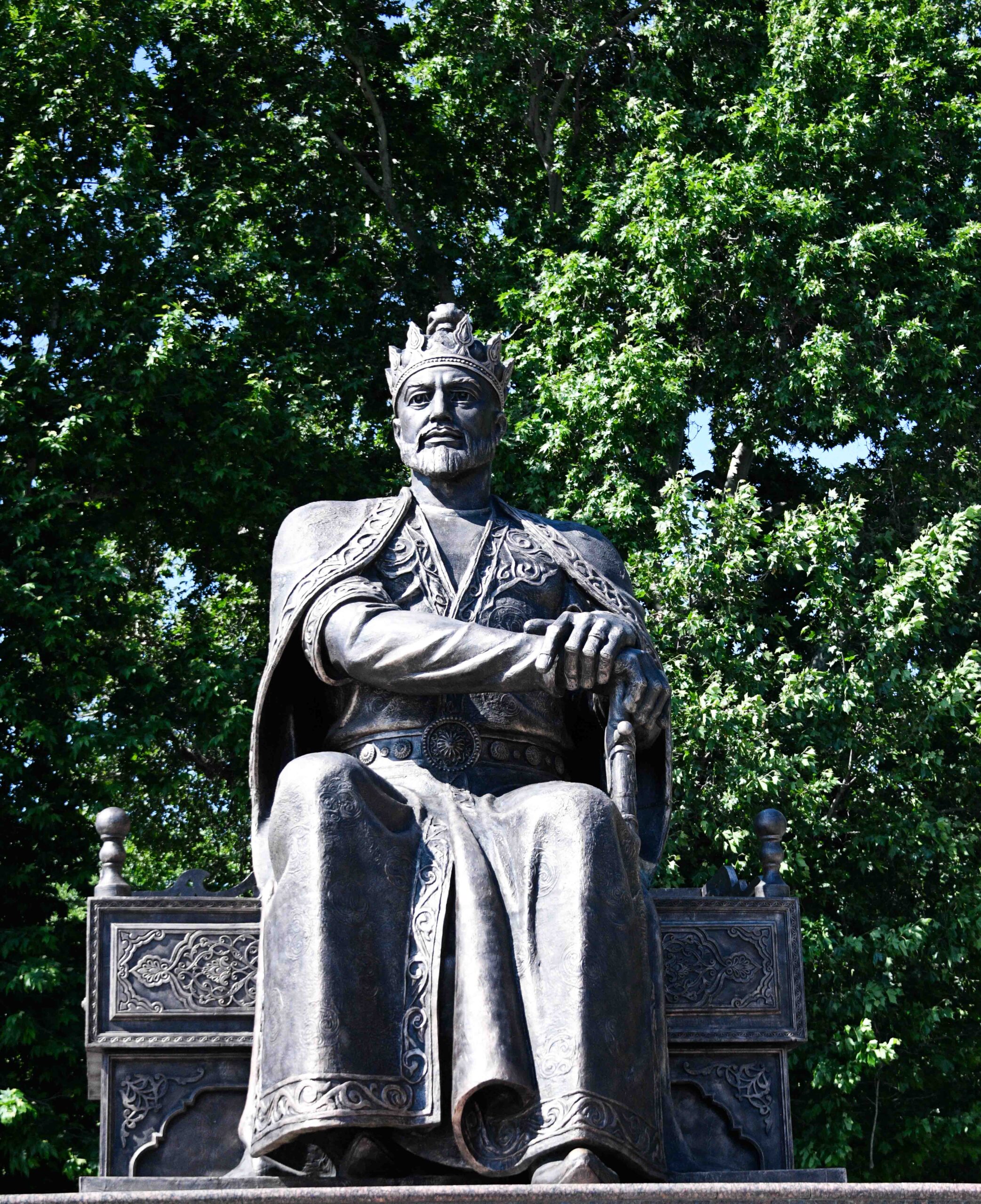
Tamerlane’s name was derived from the Persian Timur-i lang, “Temur the Lame,” which Europeans adopted during the 16th century. His Turkic name is Timur, which means ‘iron’. In his lifetime, he has conquered more than anyone else except for Alexander. His armies crossed Eurasia from Delhi to Moscow, from the Tien Shan Mountains of Central Asia to the Taurus Mountains in Anatolia. From 1370 till his death in 1405, Temur built a powerful empire and became the last of the great nomadic leaders.
Timur claimed direct descent from Genghis Khan through the house of Chagatai. He was born in 1336 at Kesh (the Green city), about fifty miles south of Samarkand, a son of a lesser chief of the Barlas tribe. Sharaf ad-Din explained that he received arrow wounds in battle while stealing sheep in his twenties, leaving him lame in the right leg and with a stiff right arm for the rest of his life.
In 1941, the body of Tamerlane was exhumed by a Russian scientist, M. M. Gerasimov. The scientist found Timur, after examining his skeleton, to be a Mongoloid man about 5 feet 8 inches. He also confirmed Tamerlane’s lameness. In his book The Face Finder, Gerasimov explains how he was able to reconstruct exact likenesses of Timur from a careful consideration of his skull.
Different sources indicate that Timur is a man with extraordinary intelligence – not only intuitive, but intellectual. Even though he did not know how to read or write, he spoke two or three languages, including Persian and Turkic, and liked to have history read to him at mealtimes. He had an aesthetic appreciation of buildings and gardens. It has been said that he loved art so much that he could not help stealing it! The Byzantine palace gates of the Ottoman capital of Brusa were carried off to Samarkand.
Known to be a chess player, he had invented a more elaborate form of the game, now called Tamerlane Chess, with twice the number of pieces on a board of a hundred and ten squares.
Religion
The question of Timur’s religious beliefs has been a matter of controversy from the beginning. His veneration of the house of the Prophet, the spurious genealogy on his tombstone taking his descent back to Ali, and the presence of Shiites in his army led some observers and scholars to call him a Shiite. However, his official religious counselor was the Hanafite scholar Abd al-Jabbar Khwarazmi. Timur’s religious practices, with their admixture of Turco-Mongol shamanistic elements, belonged to the Sufi tradition.
In religion, as in other aspects of his life, Timur was above all an opportunist; his religion frequently served to further his aims, but almost never to curtail his actions. It was in the justification of his rule and his conquests that Timur found Islam most useful.
Death
Without taking the advice of his generals to remain in Samarkand until the spring, Timur and his army planned to advance northwards without delays, encamp at various points near the river Jaxartes, and wait for the first sign of spring to strike towards China. They left Samarkand early in January on a day chosen by the astrologers as auspicious. Timur’s health suffered from the severity of the journey, and he was seriously ill. On 17 or 18 February 1405, Tamerlane died. His body was carried back and buried at the Gur-i-Mir in Samarkand.